

When the weather turns in Tuscany, you can easily keep children entertained with city visits, indoor activities at an agriturismo, truffle workshops, museums, and nearby castles. Bad weather during the Tuscan summer is rare and rarely lasts more than a day, making it more of a welcome change of pace than a real problem. Below we answer the most frequently asked questions about what to do when the sun takes a break.
What are the best activities for children in bad weather in Tuscany?
The best activities for children in bad weather in Tuscany are visits to historic town centers, cooking workshops such as making pasta or bread, visits to local markets and museums, and guided tours of castles or monasteries. These activities are actually more enjoyable when it’s grey outside and give children a direct glimpse into Italian culture.
Tuscany is a region that lends itself beautifully to adventurous learning. Children who normally show little interest in history or cooking are often delightfully surprised here. Visiting a local market in a medieval square, kneading dough for pici or focaccia, or watching a craftsman at work: these are experiences that stay with you.
- Making pasta or baking bread in a local kitchen
- Exploring a medieval town center at your own pace
- Visiting a local weekly market
- Exploring castles, monasteries, or churches
- A truffle workshop or foraging walk (perfectly doable in the rain)
Which towns in Tuscany are the most enjoyable to explore with children?
The most enjoyable towns to explore with children in Tuscany are Arezzo, Cortona, Poppi, and Bibbiena. These towns are compact, child-friendly in scale, and offer enough variety without being overwhelmingly busy. Arezzo and Poppi are particularly easy to reach from the Casentino area.
Arezzo has a beautiful historic center with wide squares where children have room to run. The town is known for its antique market and medieval architecture. Poppi is a small town with an imposing castle that immediately captures children’s imaginations: it looks like it came straight out of a fairy tale. Cortona, perched on a hill, requires a bit more walking but offers breathtaking views and a charming center. Bibbiena is the local market town of the Casentino and gives an authentic, non-touristy picture of everyday Italian life.
Can you go truffle hunting on a rainy day in Tuscany?
Yes, truffle hunting on a rainy day in Tuscany is not only possible — it is often ideal. Truffles grow underground and dogs track them by scent, which is stronger after rain. A light shower actually makes the truffle hunt easier for the dogs and more adventurous for the children.
Truffle hunting is an activity that captivates children of all ages. The combination of a working dog, muddy forest paths, and digging up a hidden treasure speaks directly to the imagination. After the hunt you can use the found truffles in a simple dish, which completes the experience. In the Casentino area truffles are plentiful, and an experienced local guide knows the best spots, even when the sky is overcast.
What can you do indoors at an agriturismo when it rains?
At a family-friendly agriturismo in Italy, a rainy day is no problem: you can enjoy cooking workshops, wine tastings for the parents, games at the big dining table, and relaxation in your own holiday home. The atmosphere of an authentic Tuscan borgo invites you to slow down and do things together that never seem to happen at home.
A rainy day at an agriturismo is not a lost day. It is the moment when families truly unwind. Children build card houses or read, parents drink coffee on the veranda as the rain sweeps over the hills, and in the afternoon a shared cooking session is on the agenda. With a holiday home with its own kitchen you also have the freedom to cook for yourself using ingredients from the local market.
How long does bad weather in Tuscany typically last in summer?
Bad weather in Tuscany lasts an average of one to two consecutive days in summer. The region has a typical Mediterranean climate with warm, dry summers. Showers in July and August are short-lived and are usually followed by clear, sunny weather. A full week of rain is exceptional during the summer months.
The Casentino area, which sits at a higher elevation than the coastal strip, can receive slightly more frequent showers than, say, the coast near Livorno. But that same altitude also brings pleasantly cool nights and fresh mornings — a welcome contrast to the heat in the flatter parts of Tuscany. Travelers visiting during the Dutch or Belgian summer holidays (mid-June to late August) can expect predominantly sunny weather with occasional showers that quickly clear the air.
Are there museums or castles nearby that are suitable for children?
Yes, in and around the Casentino there are several museums and castles that are excellent for children. The Castello dei Conti Guidi in Poppi is the most child-friendly castle in the region: well preserved, with towers, courtyards, and stunning views. The monastery of La Verna, perched on a rocky mountain peak, is also a remarkable excursion that children will not soon forget.
An overview of the most suitable day trips for families in the area:
- Castello dei Conti Guidi (Poppi) — medieval castle with imposing towers, accessible for all ages
- Santuario della Verna — dramatically situated monastery on a rocky plateau, with walking trails and viewpoints
- Museo Paleontologico (Montevarchi) — fossil museum that captivates children with prehistoric finds from the region
- Arezzo historic center — open-air museum with wide squares, churches, and the famous Piero della Francesca frescoes
- Parco Nazionale delle Foreste Casentinesi — national park with visitor centers and educational trails for children
How Novanta helps on rainy days
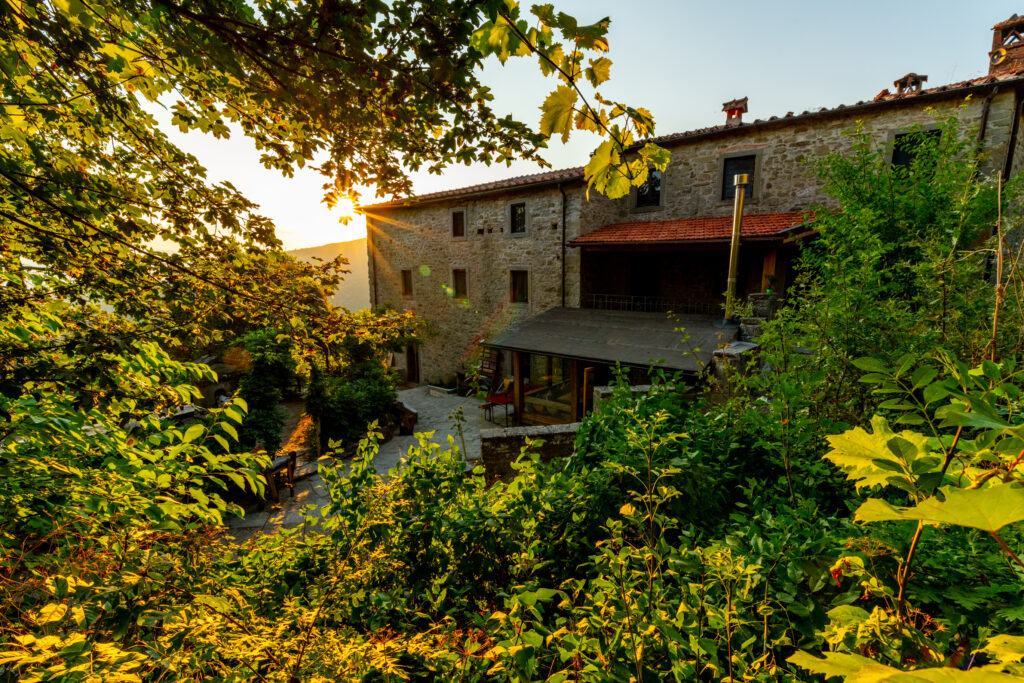
Novanta, tucked away in the Gello valley in the Casentino, is exactly the kind of place where a rainy day is not a problem but an opportunity. The borgo offers a rich mix of indoor and outdoor activities that are a perfect fit for families looking for a family-friendly agriturismo in Italy with more depth than a holiday park.
- Truffle hunts — even in overcast weather, with local guides and keen-nosed dogs
- Pasta and sausage making — a workshop that children and parents do together, with authentic Tuscan ingredients
- Wine tastings — for the parents, while the children play in the courtyard
- Private holiday homes with a kitchen — ideal for a home-cooked Italian meal on a quiet day
- Communal dining tables — for those who prefer to join a shared dinner in the spirit of cucina povera
Whether you choose a hotel room or suite for a smaller family, or one of the spacious holiday homes for multiple families together, Novanta offers the space, the activities, and the atmosphere to make even a rainy day feel like a genuine Tuscan experience. Browse the options and plan your stay on the Novanta website.
Frequently Asked Questions
What is the best time to visit Tuscany with children if you want to avoid bad weather?
The best period is from mid-June to late August, when the weather in Tuscany is most stable and sunny. July is statistically the driest month. Bear in mind that the Casentino area has a slightly higher chance of showers than the coast, but these are almost always short-lived rain showers that bring the temperature down to a pleasant level.
How far are the nearest towns and attractions from an agriturismo in the Casentino?
From the Casentino, and specifically from the Gello valley where Novanta is located, towns such as Poppi, Bibbiena, and Arezzo are reachable within 15 to 40 minutes by car. The Castello dei Conti Guidi in Poppi and the Santuario della Verna are even closer. This makes the area ideal as a base for day trips, even on rainy days.
Are cooking workshops and truffle hunts suitable for young children, or is there a minimum age?
Most cooking workshops, such as making pasta or bread, are suitable for children from around 4 years old — as long as a parent stays with them. Truffle hunts are generally suitable for children from 5 à 6 years old, as walking along forest paths requires some stamina and attention. Always check the specific age recommendations with the provider, but as a general rule: the younger the child, the shorter the outing.
What should I bring if we go truffle hunting or head into nature on a rainy day?
Pack sturdy, water-resistant walking shoes or boots for everyone, a light rain jacket, and a spare set of clothes for the children. Muddy paths are part of the experience and are actually a big part of the fun for children. A small backpack with water and a snack makes the outing more comfortable, especially for the youngest children.
Can we as a family find enough to do in bad weather without pre-booked workshops?
Yes, absolutely. Many activities in Tuscany require no reservation: medieval town centers, local markets, castles, and churches are freely accessible or have a low entry threshold. That said, for workshops such as pasta making or truffle hunting it is wise to book in advance, especially in high season, as groups fill up quickly.
What are common mistakes when planning a Tuscan holiday with children?
A common mistake is scheduling too many activities in a single day, especially with young children. Tuscany calls for a slower pace: linger over lunch, let the children play in a square, and plan one highlight per day rather than three. Another pitfall is underestimating the heat in the flat areas in July and August — opt for early morning outings and rest in the afternoon.
Is a holiday home with its own kitchen really an advantage in bad weather, or is it unnecessary?
A holiday home with its own kitchen is a significant advantage in bad weather. It allows families to cook for themselves using fresh ingrediënts from the local market, which is in itself a fun activity for the whole family. It also gives the freedom to eat at your own pace, without the pressure of restaurant reservations — ideal when children are tired or cranky after a long day.
