

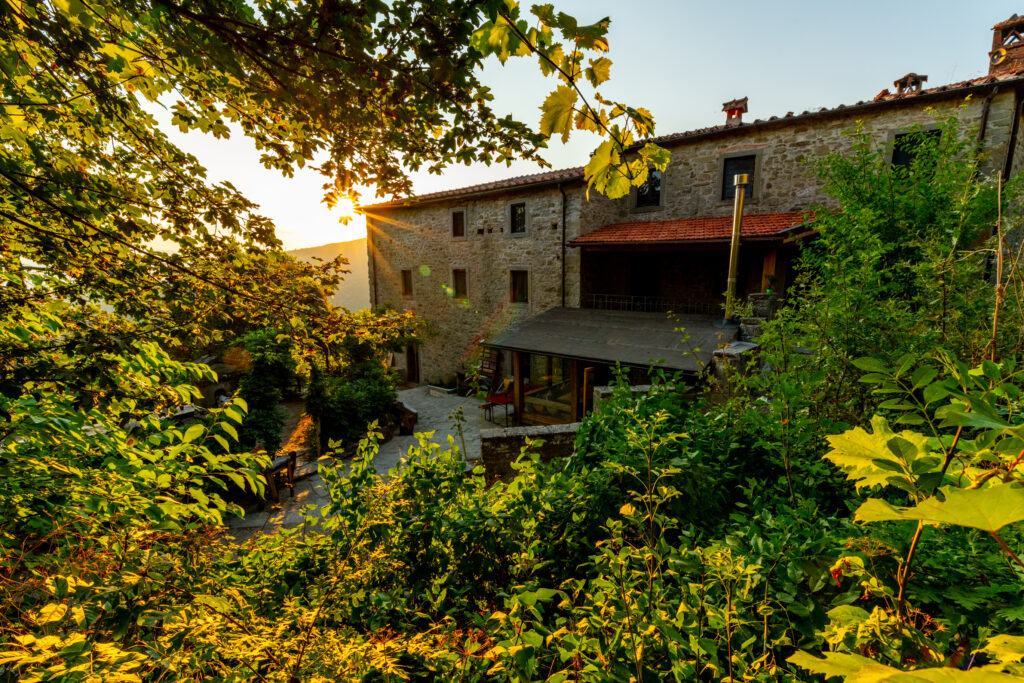
Families are increasingly choosing the Tuscan countryside over the city because nature, space, and the slow rhythm of rural life offer something Florence or Siena simply cannot: genuine relaxation without an agenda. For active families looking for an authentic Italian experience, the countryside provides an environment where children can move freely, parents unwind, and the whole family shares something together. We answer the questions most families ask before booking, one by one below.
What makes a countryside holiday in Tuscany different from a city visit?
A countryside holiday in Tuscany is all about experience, space, and slowing down, while a city visit revolves around sights, logistics, and crowds. In the countryside you live right in the landscape, eat local produce from the farm, and follow the rhythm of nature. That is a fundamentally different holiday experience, especially with children.
In a city like Florence or Arezzo you walk from museum to museum, book restaurants well in advance, and navigate busy streets with a pushchair or a teenager who would rather not put their phone away. In the countryside that pressure disappears. There are no traffic jams, no queues, and no fixed route. Children run outside, adults sit with a glass of wine on the terrace, and evening falls without hurry.
Moreover, the cucina povera, the simple, honest Tuscan cuisine, can be tasted in its most authentic form in the countryside. Not in a restaurant for tourists, but at a long shared table with ingredients from the immediate surroundings. That is a difference you can feel.
Why do families with children prefer space over sightseeing?
Families with children choose space because children, especially teenagers, do not want to walk through museums for hours on end. Space means freedom: freedom to run, explore, swim, and make friends. That freedom leads to less stress for parents and more enjoyment for children.
In the countryside you do not need to plan the day around opening times or entrance fees. Children set their own pace. They explore the grounds, jump in the pool, or follow a winding path through the woods. Parents do not have to coordinate constantly, and that makes a countryside holiday considerably more relaxing for many families than a city break.
Moreover, renting a holiday home in Tuscany with its own kitchen and outdoor space offers a basic comfort that a hotel room in the city cannot provide. Children eat when they are hungry, sleep when they are tired, and play outside without supervision from a hotel member of staff.
What activities does the Tuscan countryside offer that a city cannot?
The Tuscan countryside offers activities deeply rooted in nature and local culture, experiences that simply do not exist in a city. Think truffle hunting with a local guide, making pasta with ingredients from the land, or a ride through the forests on an e-mountain bike.
An overview of what the countryside has to offer exclusively:
- Truffle hunting, together with a local guide and trained dogs through the forest, in search of the famous Tuscan truffle
- Making pasta and sausage, authentic cooking lessons with local products and recipes passed down from generation to generation
- Wine tastings, directly at the producer, with explanations about the landscape and the grapes
- E-mountain biking, through hills and forests you would never discover so well on foot or by car
- Swimming in the river, an experience children will never forget, far from crowded beaches or indoor swimming pools
- Foraging trips, searching for edible plants and mushrooms in the immediate surroundings, together with people from the village
These are not organised tourist attractions, but real experiences that connect you with the place and the people. That is exactly what families are looking for who want to enjoy an authentic agriturismo in Tuscany with children.
Is the Tuscan countryside also suitable for teenagers and older children?
Yes, the Tuscan countryside is excellently suited for teenagers, perhaps even more so than for young children. Teenagers need freedom, challenge, and social interaction, and they find all of these in the countryside in a way that a city trip rarely offers.
In the countryside teenagers can walk around independently, make friends with other children in the holiday group, or explore the village without parents following every step. Activities such as e-mountain biking, truffle hunting, or a cooking workshop appeal to teenagers because they are active and deliver a tangible result. They are not there for a museum; they are there for the adventure.
Families travelling with several families at the same time also notice that teenagers quickly form their own group. A car-free village or borgo where children can walk around safely without traffic gives parents peace of mind and teenagers the freedom they need.
How far is the Tuscan countryside from cities such as Florence and Arezzo?
The Tuscan countryside is in many places surprisingly close to major cities. From the Casentino area, in the hills between Arezzo and the Apennines, you drive to Arezzo in approximately 30 to 45 minutes and to Florence in just over an hour. This makes a day trip to the city very easy to combine with a stay in the countryside.
That combination is ideal for many families: the peace and space of the countryside as a home base, with the option of spending a day wandering around Florence or visiting the market in Arezzo. You do not have to choose between city and countryside; you choose the countryside with the city as a day trip.
Arezzo itself is highly recommended for families: smaller than Florence, less crowded, and with an authentic centre that is not overrun by tourists. The combination of a family-friendly agriturismo in Italy as a base and Arezzo as a day destination works particularly well.
What is the best season for a family holiday in the Tuscan countryside?
The best season for a family holiday in the Tuscan countryside is the period from mid-June to the end of August, followed by September as an excellent alternative. During these months the weather is stable, the landscape is at its most beautiful, and most activities are fully available.
An overview by period:
- Mid-June to mid-July, quieter than the height of summer, pleasantly warm, green landscape and plenty of flowers. Ideal for walks and outdoor activities.
- Mid-July to the end of August, the busiest period, but also the warmest. Perfect for swimming in the river and the pool. Popular with Dutch and Belgian families during the summer holidays.
- September, the grapes are ripe, temperatures drop pleasantly, and the landscape turns golden. Fewer families, more peace. Excellent for wine tastings and truffle hunting.
May and October are suitable for couples or adventurous families without school-age children, but can be too cool for swimming. For most families the advice is: book for 2026 as early as possible, because the best places to stay in the countryside are popular and fill up quickly in the summer months.
How Novanta helps with an authentic family holiday in Tuscany
Novanta is an experience hotel tucked away in the Casentino hills, on approximately 300 hectares of rolling fields and forests bordering the Casentino National Park. It is precisely the place families are looking for when they want an authentic, non-touristy holiday in Tuscany, without the pressure of a holiday park, but with all the space and freedom of the countryside.
What Novanta concretely offers for families:
- Self-contained holiday homes with their own kitchen and 2 or 3 bedrooms, suitable for multiple families together
- Access to a 20-metre pool and a second pool, plus the river in the valley
- Activities such as truffle hunting, pasta making, e-mountain biking, and wine tastings, organised with local residents
- A car-free village: the car stays at the entrance, luggage travels to the house by 4×4
- Location approximately 30 to 45 minutes from Arezzo and just over an hour from Florence
Novanta is not a traditional luxury hotel and has no desire to be one. It is a place for families who prefer nature, authenticity, and adventure over comfort for comfort’s sake. Discover the available holiday homes and plan your stay for 2026 via the Novanta website.
Frequently Asked Questions
How far in advance should I book a holiday home in the Tuscan countryside?
For the summer months (July and August) it is strongly advisable to book at least 6 to 9 months in advance, especially for popular accommodation such as agriturismi or experience hotels like Novanta. The best houses with a privézwembad en ruime buitenruimte zijn het snelst volgeboekt. Wie in september wil gaan, heeft iets meer speelruimte, maar ook die periode wordt steeds populairder bij gezinnen die de drukte van de hoogzomer willen vermijden.
What is the difference between an agriturismo and renting a holiday home in Tuscany?
An agriturismo is a working farm or agricultural business that also offers accommodation, often with meals and activities directly connected to the farm. A holiday home is a self-contained property you rent without that agricultural context, but sometimes with comparable facilities. For families, an agriturismo offers the added value of authentic experiences such as cooking lessons and truffle hunting, while a holiday home provides more privacy and flexibility. Some accommodation, such as Novanta, combines the best of both worlds.
Can multiple families book one accommodation together in Tuscany?
Yes, and that is actually one of the most popular ways to organise a countryside holiday in Tuscany. Many holiday homes and experience hotels offer properties with 2 or 3 bedrooms suitable for multiple families at the same time, with shared outdoor spaces and a pool. The great advantage: costs are shared, children immediately have playmates, and adults enjoy company without sacrificing privacy. When booking, always check whether the house has enough bathrooms and a spacious shared living area.
Do I need a car to explore the Tuscan countryside?
In most cases a car is strongly recommended, because the countryside is poorly served by public transport and the most beautiful spots are often located outside the village centres. A hire car gives you the freedom to make day trips to Arezzo, Florence, or smaller villages in the area. Some accommodation, such as Novanta, is car-free within the estate itself, which provides extra safety for children. Plan your route in advance and download offline maps, as the mobile network in remote hilltop villages can be unreliable.
What should we pack for an active family holiday in the Tuscan countryside?
In addition to the usual holiday luggage, a few specific items are essential for an active countryside holiday: sturdy walking shoes or trail runners for every family member, a good sunscreen (the Tuscan sun is stronger than you think), insect repellent for the evening hours, and lightweight rain gear for unexpected showers in the hills. Also bring a reusable water bottle, as active activities such as e-mountain biking and truffle hunting require good hydration. Children who want to swim in the river will also need water shoes because of the pebbles on the riverbed.
Is the Tuscan countryside also suitable for families with very young children or babies?
Yes, but it requires a little extra preparation. When booking, check whether the accommodation has a cot, high chair, and a fenced pool or terrace. In the countryside there are sometimes no shops nearby, so bring enough nappies, baby food, and medicines from home. The quieter rhythm of a countryside holiday is actually ideal for babies and toddlers, because there is no strict schedule and you can easily adapt to the child’s sleep routine. Avoid the hottest hours of the day (12:00–16:00) for outdoor activities with young children.
What common mistakes should families avoid when planning a Tuscan countryside holiday?
The most common mistake is over-scheduling: a countryside holiday works best when you deliberately leave room for doing nothing. Other pitfalls include booking too late and missing the best locations, not accounting for travel time from the UK or elsewhere (driving or flying to Tuscany can easily take half a day), and expecting supermarkets to be nearby for daily shopping. Also book activities such as truffle hunting or cooking lessons in advance, as local guides and workshops have limited places and fill up quickly during peak season.
Related Articles
- Waarom kiezen gezinnen voor het Toscaanse platteland in plaats van de stad?
- How to Combine Culture and Fun Activities for Kids in Tuscany?
- Waar huur je een vakantiehuis met zwembad in Toscane?
- Vakantiepark of agriturismo: wat is beter voor een kindvriendelijke vakantie in Toscane?
- What are the benefits of a holiday home with its own kitchen for a family in Tuscany?
