

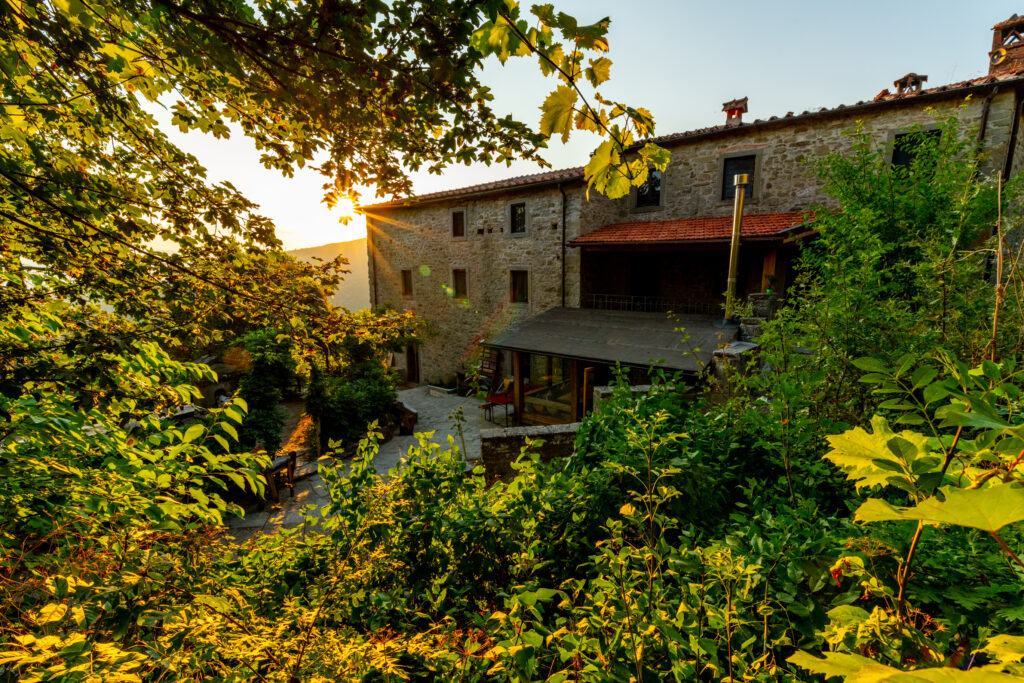
The least crowded parts of Tuscany are the mountain areas and remote valleys, such as the Casentino, the Garfagnana, and the Maremma. While Florence, Siena, and the Chianti region fill up with visitors in summer, these regions remain remarkably quiet and authentic. In this article, we answer the most frequently asked questions about quiet Tuscany, from the best regions to the activities you can do there.
Which regions in Tuscany attract the fewest tourists?
The quietest parts of Tuscany are the Casentino, the Garfagnana, the Mugello, and the Maremma. These areas lie off the beaten tourist track and attract mainly Italians themselves, which makes them particularly authentic. Those looking for a family-friendly agriturismo in Italy without the crowds of the major cities will find exactly what they are looking for here.
The Casentino is a wide mountain valley east of Arezzo, surrounded by dense forests and bordering one of Italy’s oldest national parks. The Garfagnana, north of Lucca, is wilder and less developed. The Maremma in the south has a rugged coastline and vast maquis vegetation. None of these areas feature in the top ten of most visited Tuscan destinations, and that is precisely their strength.
When is Tuscany at its busiest and when is it relatively quiet?
Tuscany is at its busiest in July and August, with a second peak around Easter and in May. The absolute peak crowds fall in the last two weeks of July and the first two weeks of August, when both Italians and Northern Europeans go on holiday en masse. Outside those periods, and certainly in the remote hills, it is noticeably quieter.
In the less touristy regions such as the Casentino, this distinction is less pronounced. Even in August it remains pleasantly quiet there compared to the cities. Summers are also cooler than in the coastal towns, thanks to the altitude and the forested surroundings. For families travelling during the Dutch or Belgian summer holidays, this is an important advantage.
Why are the Tuscan hills quieter than the cities?
The Tuscan hills attract fewer tourists because they are less well known, harder to reach by public transport, and not connected to the classic “Tuscany route” from Florence to Siena. As a result, they mainly attract travellers who consciously choose peace, nature, and authenticity, rather than the crowds drawn to Instagram-worthy spots.
Moreover, the hills lack the tourist infrastructure that attracts crowds: no large hotel chains, no souvenir shops, no guided tours with flags. What is there: local residents living their own lives, agriturismos rooted in the region, and a landscape that has barely changed in recent decades. For families looking to rent a holiday home in Tuscany without feeling like they are in a tourist bubble, the hills are the ideal choice.
What are the advantages of a holiday in a quiet part of Tuscany?
A holiday in a quiet part of Tuscany offers more space, more contact with local culture, and lower price pressure than the well-known tourist areas. Children can roam freely, families meet in natural settings, and the daily hustle of popular destinations stays far away.
The concrete advantages at a glance:
- Less traffic and parking pressure – in remote valleys, using a car within the village is often unnecessary
- Lower costs – restaurants, markets, and local products are cheaper than in tourist centres
- Authentic experiences – from truffle hunting to making pasta with local residents
- More space for children – large grounds, rivers, and forests to explore
- Cooler temperatures – the hills are more pleasant in summer than the coastal towns
- More sustainable travel – less pressure on overtouristed spots and more support for local economies
How far are the quiet areas from the well-known sights?
The quiet hill areas of Tuscany are typically one to one and a half hours’ drive from the most famous sights. From the Casentino you can drive to Arezzo in about 45 minutes, and to Florence or Siena in just over an hour. This makes a day trip to the city easy to combine with a stay in the tranquillity of the valley.
This is an important consideration for families who want the best of both worlds: visiting a museum or historic city during the day, and returning in the evening to a place where it is quiet, the stars are visible, and children can play outside. The distance is large enough to escape the crowds, but small enough to remain flexible.
What activities are available in the less crowded parts of Tuscany?
In the quiet hill areas of Tuscany there are plenty of activities for families, active travellers, and nature lovers. The emphasis is on outdoor life, local culture, and craftsmanship, not on organised attractions. This makes it particularly well suited for an agriturismo in Tuscany with children.
Popular activities in the less crowded regions include:
- Hiking and mountain biking through forests and along hill paths, also suitable for children
- Truffle hunting with local guides and their dogs – a unique and educational experience
- Swimming in rivers and natural pools – safer and quieter than crowded beaches
- Making pasta and bread in the tradition of cucina povera
- Wine tastings at small, family-run cantinas
- Foraging tours through forests and fields with local experts
- Visits to medieval villages and monasteries without queues or tourist prices
How Novanta helps with a quiet, authentic holiday in Tuscany
Novanta is tucked away in the Gello valley in the Casentino, one of the quietest and greenest corners of Tuscany. The borgo has 16 houses and a church, surrounded by around 300 hectares of fields and forests, bordering the Casentino National Park. There is no mass tourism here, no souvenir shop, and no queue. What there is: a community built on authenticity, nature, and shared tables.
What Novanta concretely offers for families:
- Self-contained holiday homes in Tuscany with their own kitchen, 2 or 3 bedrooms – ideal for families or multiple families together
- Access to two swimming pools, a river, and vast nature to explore freely
- Car-free village: the car stays at the entrance, luggage travels by 4×4 – children play safely in the street
- Experiences such as truffle hunting, pasta making, e-mountain biking, and river trips – together with local residents
- Sustainable management of the estate, with local and seasonal products
For smaller families who do not need a self-contained house, hotel rooms and suites are also available. Would you like to find out more or plan a stay? Contact Novanta and discover which option best suits your family and travel group.
Frequently Asked Questions
Is a car necessary to explore the quiet parts of Tuscany?
For the remote hill areas such as the Casentino and the Garfagnana, a car is virtually essential, as public transport is limited there. However, from a centrally located accommodation such as Novanta, you can enjoy most daily activities — hiking, swimming in the river, cooking with local products — without a car. For excursions to nearby towns or villages, a rental car is the most practical and flexible option.
What is the best age for children to visit an agriturismo in Tuscany?
In fact, every age is suitable, but families with children between 4 and 14 years old benefit the most from a stay in the Tuscan hills. Young children enjoy the safe, car-free environment and outdoor life, while older children can actively participate in experiences such as truffle hunting, e-mountain biking, or pasta making. Toddlers and babies benefit from the peace and space that an estate offers compared to a busy city.
How far in advance should I book a stay in the quieter parts of Tuscany?
For the summer holidays — especially the months of July and August — it is strongly recommended to book at least four to six months in advance, even though these regions are less crowded than Florence or the Chianti. Small-scale accommodations such as holiday homes on a borgo have limited capacity, which means they fill up faster than large hotels. Outside the high season, for example in May, June, or September, two to three months in advance is usually sufficient.
Are the quiet hill areas of Tuscany also suitable for a holiday outside summer?
Absolutely — spring and autumn are even the favourite seasons of many returning visitors. In May and June the meadows are in bloom, temperatures are pleasant, and the roads are empty. September and October are ideal for truffle hunting, grape harvesting, and autumn walks through golden forests. Winters are quieter and cooler, but offer a completely different, atmospheric picture of Tuscan country life.
What are common mistakes when planning a quiet holiday in Tuscany?
A common mistake is planning too many day trips to major cities, causing the peace of the stay to be lost and the holiday to feel like a tour. Another pitfall is expecting remote areas to offer the same tourist services as Florence or Siena — supermarkets, restaurants, and shops close earlier there and are less numerous. Plan deliberately: choose één or two city day trips and leave the rest of the time open for spontaneous discoveries close to your accommodation.
Can I also buy local products in the quiet parts of Tuscany to take home?
Certainly, and that is precisely one of the highlights of a stay in the less touristy regions. Think of local olive oil, honey, dried porcini mushrooms, truffle paste, pecorino cheese, and artisan wines — often available directly from the producer or at small weekly markets. Prices are noticeably lower than in tourist centres, and quality is often higher because you are buying directly from the source.
How sustainable is a holiday at a remote agriturismo or borgo in Tuscany?
A stay at a small-scale, locally managed accommodation such as an agriturismo or borgo is generally one of the more sustainable holiday options in Italië. You directly support the local economy, consume seasonal and regional products, and do not contribute to the overloading of popular tourist attractions. Preferably choose accommodations that actively commit to sustainable estate management, local employment, and environmentally conscious practices — that way you combine relaxation with a positive impact.
