

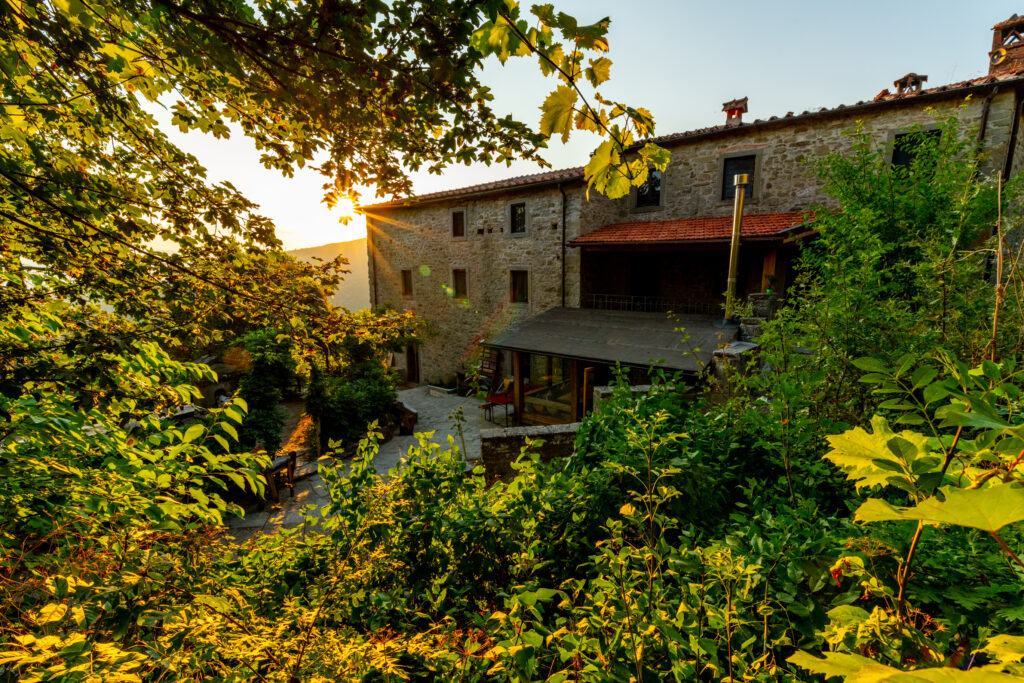
Planning a holiday in Tuscany that both parents and children enjoy means choosing a region with space, nature, and authentic experiences rather than busy cities or mass tourism. The key lies in an agriturismo or holiday home in the hills, combined with the right travel period and activities that genuinely engage children. The questions below help you plan a holiday step by step that works for the whole family.
Which region in Tuscany is most suitable for families?
For families, the Casentino — the green hill region northeast of Arezzo — is one of the most suitable areas in Tuscany. The area borders a national park, has virtually no mass tourism, and gives children real space to explore: forests, rivers, rolling fields, and abandoned villages. That is precisely what sets an authentic family holiday in Tuscany apart from a standard beach holiday.
The Casentino is less well known than the Chianti region or the Maremma coastline, but that is actually an advantage. Roads are quieter, villages are more authentic, and children can roam freely without you constantly having to watch for heavy traffic. The area is also easily accessible from Arezzo, which is less than two hours’ drive from Florence.
Other family-friendly regions include the Maremma (for those who also want the beach) and the Valdichiana (flat and cycle-friendly), but for those who combine nature, adventure, and authenticity, the Casentino is the strongest choice.
What is the best time to travel to Tuscany with children?
The best time for a family holiday in Tuscany is June or September. Temperatures are pleasant, crowds are manageable, and outdoor activities are easy to plan. July and August are also possible, but heat and higher occupancy require good preparation, especially with young children.
During the Dutch and Belgian summer holidays, from mid-June to the end of August, most families travel. August is the busiest and hottest time. Those with flexibility should choose the second half of June or the first three weeks of September: the swimming pools are open, nature is in full bloom, and you encounter fewer day-trippers at popular spots.
Planning activities early in the morning — such as hiking or truffle hunting — and spending the afternoon by the pool is a tried-and-tested summer routine that both parents and children can sustain well.
What can children do at an agriturismo in Tuscany?
At a child-friendly agriturismo in Italy, children can take part in activities such as making pasta, truffle hunting, foraging tours, e-mountain biking, and swimming. These are experiences children do not easily forget and that connect them with the local culture and nature, without the need for an entertainment programme.
What makes an agriturismo in Tuscany so special for children is the freedom. No organised children’s disco or animation team, but real space: exploring a village, making friends with other children, discovering a river. Teenagers often appreciate that freedom more than young children, but for younger children too, the variety of nature and activities is more than enough.
- Making pasta and sausages with local ingredients and guidance
- Truffle hunting with a real truffle hunter and his dog
- E-mountain biking through forests and along hill trails
- Swimming in an outdoor pool or the river
- Foraging tours through the surrounding landscape
- Wine tasting for the parents, while children play freely
How do you choose the right accommodation for a family holiday in Tuscany?
The right accommodation for a family in Tuscany has its own kitchen, sufficient sleeping space, outdoor space, and access to a swimming pool. Renting a self-contained holiday home in Tuscany is more practical for most families than a hotel room: you have your own routine, your own mealtimes, and space for children to play.
When making your choice, consider the following points:
- Bedrooms and layout: Allow at least one bedroom per couple and per older teenager. Two or three bedrooms are the norm for most families.
- Private kitchen: Essential for families with young children or picky eaters. It also gives you the freedom to buy local produce at the market.
- Swimming pool: A private or shared pool is not a luxury in the Tuscan summer heat — it is a necessity.
- Location: Choose a spot in the hills with little traffic, so children can move around safely. A car-free village or grounds are a major advantage.
- Group size: Travelling with multiple families? Then choose a holiday home large enough, or a location with several houses on one site.
For smaller families who do not need a full house, studios, suites, or cottages are a good alternative. Browse the available holiday homes in Tuscany if you are travelling with a larger group.
How do you practically plan the trip to Tuscany with children?
The most practical way to travel to Tuscany with children is by car or via a flight to Florence, Pisa, or Bologna, followed by a hire car. Flights to Italy from the Netherlands or Belgium take two to two and a half hours. By car, Tuscany can be reached in a day, with a stopover in Switzerland or northern Italy.
Practical tips for the journey:
- Book a hire car with sufficient boot space, especially if you are travelling with multiple families
- Do not drive too far on the first day: a stopover makes the journey more manageable for children
- Check whether the accommodation collects luggage from the car park, so children do not have to carry bags
- Bring a basic supply of familiar snacks for the first evening
- Set expectations: an agriturismo in the hills is not a holiday park in Tuscany with water slides, but a genuine experience
What do children eat on an authentic Tuscan holiday?
Children eat surprisingly well in Tuscany, because the local cuisine revolves around simple, familiar flavours: pasta, bread, cheese, grilled meat, and fresh vegetables. The Tuscan cucina povera, literally “poor kitchen”, is based on few ingredients of high quality, which makes it more accessible for most children than elaborate restaurant dishes.
Meals at long tables, shared with other families or guests, are a special experience. Children who have made their own pasta will also eat that pasta. That is the power of culinary activities as part of the holiday: it increases the willingness to try new flavours.
Local markets are also ideal for introducing children to fresh produce: olive oil, truffle paste, local cheeses, and fresh fruit. Those who rent a holiday home in Tuscany with their own kitchen can easily combine this with cooking for themselves.
Which day trips from Tuscany are fun for the whole family?
From the Casentino, day trips to Arezzo, the Casentino National Park, the medieval town of Poppi, and the waterfalls at Camaldoli combine well with a family holiday. Florence and Siena are reachable for a day trip, but are intense for young children. Choose shorter outings with plenty of space and few queues.
Good day trips for families:
- Poppi: Small medieval town with a castle, easily combined with an outdoor lunch
- Casentino National Park: Walking trails of various lengths, also suitable for children
- Arezzo: Lively city with a market, less crowded than Florence
- Camaldoli: Monastery in the forest with a pharmacy selling local products
- Lago di Bilancino: Lake north of Florence, suitable for swimming and canoeing
Deliberately limit the number of day trips. One of the greatest advantages of an agriturismo in Tuscany with children is precisely that you do not have to drive somewhere every day. The valley, the pool, and the on-site activities are more than enough for many children.
How Novanta helps with a family holiday in Tuscany
Novanta is an experience hotel in the Casentino hills, tucked away in the secluded Gello valley, and offers exactly what families are looking for who want an authentic, active holiday in Tuscany without mass tourism or excessive luxury. The concept is built around experience, nature, and community — not around service and pampering.
- Self-contained holiday homes with 2 or 3 bedrooms, a private kitchen, and outdoor space, suitable for families and multiple families together
- Car-free village: the car stays at the entrance, luggage goes with the 4×4 to the house
- Two swimming pools and access to the river in the valley
- On-site activities: pasta making, truffle hunting, e-mountain biking, foraging tours, and wine tastings
- 300 hectares of rolling fields and forests, bordering the Casentino National Park
- Meals at long tables based on the Tuscan cucina povera, shared with other guests
Want to know which accommodation best suits your family or group? Browse the available holiday homes or the hotel rooms and cottages on the Novanta website and plan your stay in the Tuscan hills.
Frequently Asked Questions
From what age can children take part in activities such as truffle hunting and pasta making?
Most activities at an agriturismo in Tuscany are suitable for children from around 5 to 6 years old. Making pasta is fun even for toddlers, as long as an adult is present. Truffle hunting with a dog is an experience for children of all ages, but teenagers generally get the most out of it because they better understand the context. E-mountain biking is generally suitable for children who can cycle independently, usually from around age 10.
Is an agriturismo in Tuscany also suitable for children who are not keen on nature?
Yes, especially if you choose a location with a swimming pool, on-site activities, and enough variety. Not every child is immediately enthusiastic about hiking or foraging tours, but the combination of freedom, food, water, and making new friends works for most children. Structure the day with a morning activity and a free afternoon at the pool, and there will be something for every type of child.
What are common mistakes when planning a family holiday in Tuscany?
The biggest mistake is trying to see too much in too little time. Cities like Florence and Siena are beautiful, but intense with young children: long walks, little shade, and many queues. A second pitfall is booking in August without accounting for the heat: always plan a swimming pool and schedule activities early in the day. Finally, many families underestimate how long the drive to a remote agriturismo takes after arriving at the airport, especially when children are tired.
How far in advance should you book a holiday home in Tuscany for the summer?
For a stay in July or August, it is wise to book at least six to nine months in advance, especially if you want a specific location or a larger house for multiple families. Popular agriturismi with family-friendly facilities such as a privézwembad and on-site activities fill up quickly in summer. Those travelling in June or September have a little more flexibility, but even then: booking earlier gives more choice and often a better price.
Can I combine a family holiday in Tuscany with a beach holiday?
You can, but it requires realistic planning. The Maremma coast is approximately one and a half à two hours’ drive from the Casentino. A day trip to the beach is feasible, but do not do this too often: the driving takes time and energy that you could also spend at the location itself. A better approach is to split the holiday: start with a week in the hills and finish with two à three days on the coast, or vice versa.
What is best to bring when travelling with children to an agriturismo in the Tuscan hills?
In addition to the usual holiday luggage, a few things are particularly useful: good walking shoes for children (even for short paths), an insect repellent spray for the evening, high-factor sunscreen, and a small backpack per child for day trips. Also bring a basic set of familiar snacks and breakfast items for the first morning, as a local supermarket in remote valleys can sometimes be a fifteen-minute drive away.
Is it possible to plan an authentic holiday in Tuscany as a family on a limited budget?
Yes, especially if you travel outside the high season and choose a holiday home with its own kitchen. By cooking for yourself using produce from the local market, you save considerably on restaurant costs. Many of the most beautiful activities in Tuscany are free or inexpensive: hiking in the national park, swimming in the river, exploring villages. Limit paid outings to één or two highlights, such as a truffle tour or a cooking workshop, and fill the rest with what nature and the surroundings have to offer.
