

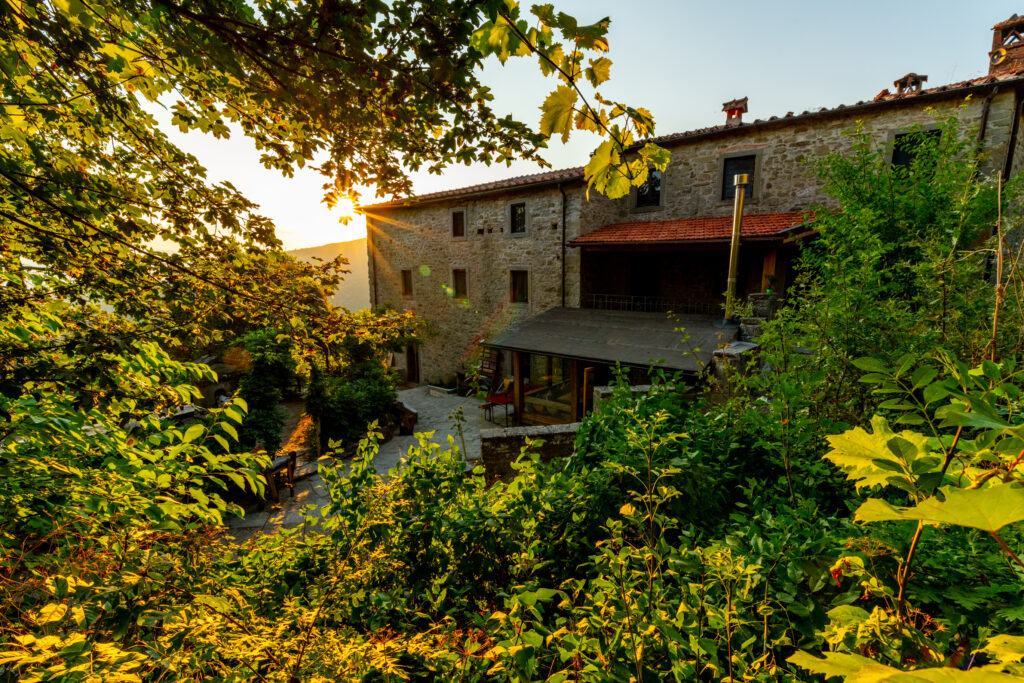
The quieter side of Tuscany with children is best found in the lesser-known inland areas: the Casentino valley, the Garfagnana, and the Maremma are regions where tourists rarely venture, nature is overwhelming, and life still moves at an Italian pace. For families seeking genuine peace without sacrificing adventure and experience, these are the places that make all the difference.
Below we answer the most frequently asked questions about a child-friendly, peaceful holiday in Tuscany, from the best regions to the ideal time to travel and the most enjoyable activities for teenagers.
Which parts of Tuscany are the least touristy?
The least touristy parts of Tuscany are found in the east and north of the region: the Casentino valley near Arezzo, the Garfagnana in the north, and the Maremma along the southern coast. Here you won’t find busloads of day-trippers, no queues for museums, and no inflated prices. What you will find: endless forests, medieval villages, and a living farming tradition.
The Casentino is perhaps Tuscany’s best-kept secret. Nestled between the Apennines and the Casentino National Park, the narrow valley roads attract barely any international tourists. The villages here are authentic because they always have been, not because they’ve been spruced up for the camera. Anyone looking for a family-friendly agriturismo in Italy that isn’t caught in a tourist bubble would do well to explore this part of the region.
The Garfagnana, north of Lucca, is similar: a mountainous area with small market towns, chestnut forests, and scarcely a tourist in sight. The Maremma in the south offers a different kind of tranquility: vast coastal wetlands, wild horses, and marshland bordering the Tyrrhenian Sea.
What makes a Tuscan holiday suitable for children?
A Tuscan holiday is ideally suited for children because the region offers a rare combination of freedom, nature, and genuine experience. Children can play outside without the danger of heavy traffic, discover animals, help in the kitchen, and make friends with other holidaying children, all in an environment that feels like one big adventure.
What sets Tuscany apart from a standard holiday park is the absence of artificial entertainment. There’s no need for an animation team when there’s a river to explore, truffles to hunt in the forest, and pasta being made at a long table with other families. Those kinds of experiences stay with children, even when they become teenagers.
- Space to move freely without constant supervision
- Sensory experiences such as cooking, foraging trips, and wildlife spotting
- Communal meals that encourage social interaction
- Nature as a playground: rivers, forests, hills
- No tourist noise to disrupt the rhythm
For families considering an agriturismo in Tuscany with children, the rule is: the less it resembles an organized holiday park, the more children can truly be themselves.
How far from civilization do you need to go for real peace in Tuscany?
For genuine peace in Tuscany, you don’t need to head to the far corners of the region: an hour or two’s drive from Florence or Arezzo is enough to be completely away from the tourist crowds. The key lies not in the distance, but in the altitude and direction. The hilltop villages in the inland areas are sometimes just twenty minutes from a provincial town, yet feel like a different world.
What makes the difference is infrastructure, or rather the lack of it. A village without a through road attracts no through traffic. A valley without signposting to a well-known attraction remains undiscovered. That is precisely why abandoned borghi, old Italian hamlets, are such a special holiday destination for families seeking peace without having to fly far.
In practical terms: look for a location at least ten kilometers from a main tourist route. The road leading there may be narrow. That’s not an inconvenience, that’s the first sign you’re in the right place.
What activities are available in quiet Tuscany for families with teenagers?
In quiet Tuscany there are plenty of activities for families with teenagers: from truffle hunting in the forest and e-mountain biking through the hills to pasta making, river trips, and wine tastings for the adults. These are experiences teenagers won’t find in a theme park, but ones they will remember.
Teenagers often tire quickly of passively lounging by a pool. They want to do something that feels like a challenge or a discovery. This makes the Tuscan inland areas surprisingly well suited for this age group.
- Truffle hunting: With a local guide and a keen nose through the forest, exciting, fragrant, and always worth a conversation at the dinner table.
- E-mountain biking: The rolling hills become far more accessible with electric assistance, even for less experienced cyclists.
- Pasta making: Not as a tourist activity, but as a real cooking lesson with local ingredients and a result you eat that evening.
- River trips: Swimming, wading, and exploring in a pristine riverbed is for many teenagers one of the most liberating experiences of the holiday.
- Foraging trips: Searching for wild herbs, edible plants, and mushrooms with someone who knows the valley like the back of their hand.
The combination of physical activity, culinary experience, and unspoiled nature makes this type of holiday appealing for teenagers who would otherwise be hard to peel away from their screens.
When is the quietest time to visit Tuscany with children?
The quietest time to visit Tuscany with children is June (before the Italian school holidays begin) or September, when the summer crowds thin out but the weather is still excellent. August is the busiest month for Italians themselves and brings more visitors even to the quieter areas.
For families from the Netherlands and Belgium there is a practical constraint: school holidays largely determine the travel window. Mid-June to late August is realistic. Within that window, the rule is: the earlier in June, the quieter. The first two weeks of June are ideal — the pool is already warm enough, temperatures are pleasant, and most Italians are still at work.
September is the best month for those with flexibility. Grapes are harvested, the air is clearer, prices drop, and the roads are empty. Children who are already in school will unfortunately miss that month, but for families with young children or flexible school arrangements it comes highly recommended.
Can you rent an entire village in Tuscany for a group?
Yes, in Tuscany you can rent an entire village or borgo for a group — this concept exists and is ideally suited for multiple families who want to holiday together without sacrificing privacy. Having your own village means shared facilities such as a pool, but also the freedom of a separate holiday home per family.
This is a growing trend among groups of friends and families who want to plan a joint holiday without the compromises of a hotel. Each family has its own bedrooms, its own kitchen, and its own rhythm, while the children play together outside and meals can be shared whenever everyone feels like it.
If you’re looking for a holiday home in Tuscany for a larger group, pay attention to these points:
- Are the houses self-contained or shared? Self-contained units per family offer more privacy.
- Is there a shared outdoor area or pool for the group?
- How far is the location from a supermarket or village for daily shopping?
- Is the borgo car-free? That is a major advantage for families with young children.
How Novanta helps with a peaceful family holiday in Tuscany
Novanta is an experience hotel tucked away in the Gello valley in the Casentino, surrounded by approximately 300 hectares of forests and fields bordering the Casentino National Park. The borgo has sixteen houses and offers both self-contained holiday homes and hotel rooms, suitable for families of various sizes and for groups of multiple families together.
What Novanta concretely offers for families seeking peace and adventure:
- Car-free village: The car stays at the entrance, luggage is transported by 4×4, children play safely outside without traffic.
- Two swimming pools and access to the river in the valley.
- Experiences with local guides: truffle hunting, pasta making, e-mountain biking, foraging trips, and wine tastings.
- Self-contained holiday homes with their own kitchen and two or three bedrooms, ideal for multiple families booking together.
- Sustainable approach: local produce, energy-efficient systems, and respect for the environment.
Novanta is not a holiday park and not a five-star hotel. It is a place for families who value nature, authenticity, and genuine experience over pampering. Browse the available holiday homes in Tuscany or the hotel rooms and discover which option best suits your family or group.
Frequently Asked Questions
How far in advance should I book an agriturismo or borgo in Tuscany for the summer holidays?
For a stay in June or July it is wise to book at least four to six months in advance, especially if you are going with multiple families and want self-contained holiday homes. The best locations in the quieter inland areas have a limited number of units and fill up quickly, precisely because they are popular with families who deliberately choose peace and quiet. If you wait too long, you will be left with the busier alternatives you were trying to avoid.
What is a realistic budget for a week in Tuscany with children in a quiet borgo?
A week in a self-contained holiday home in a quiet Tuscan borgo costs a family of four on average between €1,200 and €2,500, depending on the season, location, and facilities. Activities such as truffle hunting or pasta making are on top of that, but are generally affordable per person (€30–€80 per activity). Compared to an all-inclusive holiday park in a busy tourist area, you give your children a far richer and more authentic experience for a similar budget.
How do I keep young children (under 6) entertained in a quiet Tuscan village without an entertainment programme?
Young children need surprisingly little organized entertainment when the environment itself serves as a playground: a swimming pool, a garden, chickens in the yard, or a stream nearby are more than enough for toddlers and young children. The absence of an animation team is actually an advantage, as children then learn to explore and play on their own without constant stimulation. Practical tip: bring familiar toys for quieter moments and plan day trips in the morning, so that the afternoon siesta (for children and parents alike) becomes a fixed and calming part of the daily rhythm.
Is a car really necessary for a holiday in the Tuscan inland areas?
Yes, for most quiet areas in the Tuscan inland a hire car is virtually indispensable, especially for families with children. Public transport in areas such as the Casentino or the Garfagnana is limited and not geared towards tourist routes. A car gives you the freedom to visit local markets, make day trips to nearby villages, and do your shopping without being tied to a timetable. Expect narrow roads and hairpin bends: a compact car is more practical than a large SUV.
What if my child doesn't like 'doing nothing' and gets bored quickly on holiday?
A quiet holiday in Tuscany does not mean there is nothing to do — quite the opposite. The key is to plan one or two activities per day in advance that match your child’s interests, such as a truffle hunt, a river trip, or a cooking workshop. Children who get bored easily actually thrive in an environment where they can explore and experiment on their own, without the sensory overload of a theme park that leaves them feeling jaded after just one day. Discuss together before you leave which activities appeal most, so your child feels co-ownership of the holiday plans.
Are there medical facilities nearby in case something happens to one of the children?
In most quiet areas of Tuscany, a GP surgery or small hospital outpatient clinic is available within twenty to thirty minutes’ drive in the nearest provincial town. Italy has a well-functioning public health system, and with a valid European Health Insurance Card (EHIC or its successor) you are entitled as an EU citizen to emergency medical care under the same conditions as Italian citizens. Always bring a well-stocked first aid kit for minor issues such as insect bites, grazes, or sunburn — these are more common on an active outdoor holiday.
How do I combine a stay in a quiet borgo with a day of culture in Florence or Siena?
From most quiet inland areas of Tuscany you can reach Florence or Siena within one to one and a half hours’ drive, making a perfect day trip possible without giving up your peaceful base. Plan such an outing on a weekday and set off early in the morning to get ahead of the worst crowds: before 9 a.m. the famous squares and churches are still relatively quiet. Return to the borgo afterwards for a late lunch or a swim in the pool — that way you combine the best of both worlds without over-planning the holiday.
