

Tuscany and a rental car seem inextricably linked. The narrow winding roads, the remote agriturismos, the freedom to spontaneously drive into a village — for many families, a car feels like an obvious choice. But is it really? A family holiday in Tuscany without your own transport is more feasible than most travelers think, especially if you consciously choose a location that makes it possible.
The key lies in the approach: not trying to see as much as possible, but truly getting to know one place. That requires a different mindset, but also offers something a road trip rarely provides — peace, rhythm, and a genuine connection with the surroundings.
Why Tuscany is less car-dependent than you’d think
Tuscany has a reputation as a region you need to explore by car, but that reputation is only partially accurate. Cities like Arezzo, Cortona, and Siena are excellently accessible by train and have good bus connections. Those staying near a larger city can explore a large part of the region without ever sitting behind the wheel.
Moreover, the need for a car changes entirely when you choose accommodation where the immediate surroundings already have plenty to offer. Walking trails through the forest, a river within walking distance, activities on the grounds themselves — in that case, the car is not a means to enjoy yourself, but an unnecessary obligation.
From the airport to the Tuscan hills without a steering wheel
The most practical option for families traveling from the Netherlands or Belgium is to fly to Pisa or Florence. Both airports have direct train connections to Arezzo, the regional hub for the Casentino area. From Arezzo, buses run toward the hill villages, and many accommodations offer a pickup service for guests arriving without a car.
The journey takes longer than with a rental car, but that doesn’t have to be a disadvantage. A train ride through Tuscany is an experience in itself — especially for children watching vineyards and medieval towns glide past. Those making the crossing by car or camper van from the Netherlands can also opt for a combination: drive to the nearest train station and leave the car there.
What you miss — and what you gain — without a car
To be honest: without a car, you leave part of Tuscany unexplored. Spontaneously descending to an unknown borgo, visiting a remote beach on the coast, or making day trips to Siena and San Gimignano becomes considerably harder. For families who see Tuscany as a starting point for a road trip, a car is often a logical choice.
But those willing to let that go gain something in return. No parking stress in narrow streets, no arguments about who drives after a wine tasting, no children sitting bored in the back of the car. Instead: walking through the landscape, cycling along unpaved paths, and the freedom of a place that already has everything you need.
- Less logistical stress for parents
- Children who move more freely and discover more at their own pace
- A lower ecological footprint during the holiday
- More room for spontaneous encounters with locals and fellow travelers
- No tiring driving days that eat into relaxation time
Activities and day trips from one base
Staying in one fixed location works best when that place offers enough variety to fill the entire holiday. In the Casentino area, that means: hiking routes through the National Park, truffle hunting with local guides, e-mountain biking over the hills, and a river where children can play for hours. Activities like pasta making or a wine tasting don’t even require you to leave the door.
For those who do want to explore the region for a day, there are regular bus connections from Arezzo to smaller villages in the area. A day in Cortona or a visit to the Benedictine abbey of Camaldoli is perfectly combinable with public transport. It requires some planning, but also offers a different kind of travel experience — calmer, more focused, without the rush of a car.
Tips for families who want to explore Tuscany car-free
A car-free holiday in Tuscany works best with good preparation. That starts with choosing your accommodation: make sure the location itself has enough to offer and that a pickup service is available from the nearest station or parking area.
- Choose accommodation with a car-free village or grounds — so the car doesn’t need to come onto the grounds and conscious movement is the norm.
- Book a pickup service in advance — many small-scale accommodations offer this, but ask about it explicitly when making your reservation.
- Count on train + bus as your backbone — the combination of Arezzo train station and local bus services covers a large part of the Casentino area.
- Plan on-site activities as your foundation — this reduces the need for daily travel and gives the holiday more rhythm.
- Bring an e-bike or rent one on-site — ideal for families with older children who want to explore independently.
- Accept that you won’t see everything — and realize that this is precisely the strength of a base-holiday.
How Novanta makes a car-free holiday in Tuscany possible
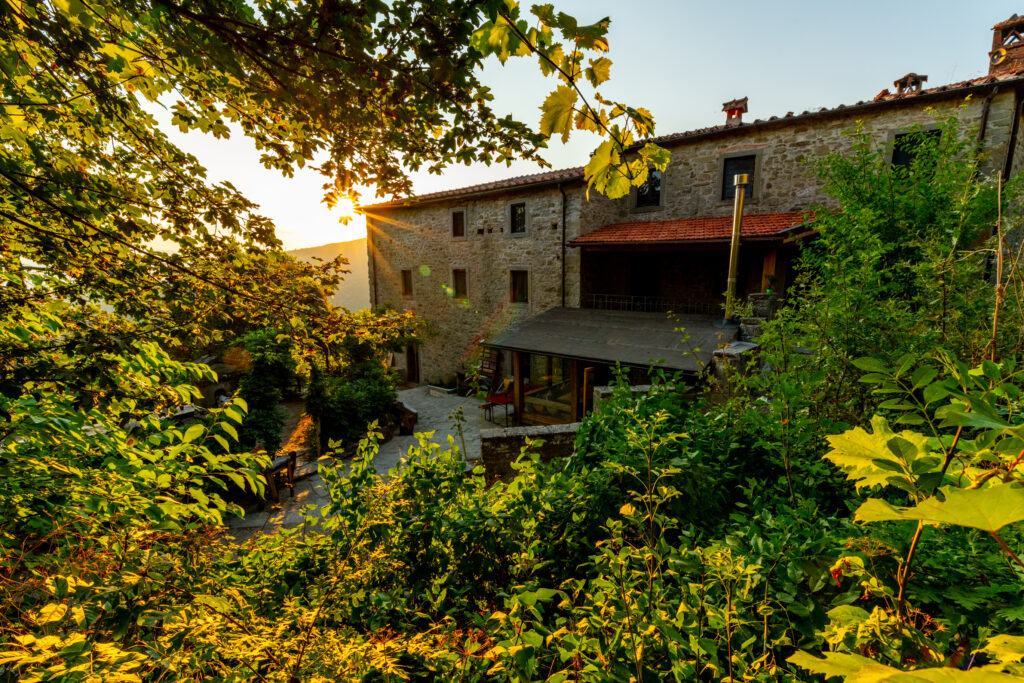
Novanta is built around exactly this principle. The borgo sits high in the Casentino hills, bordering the National Park, and is naturally car-free: visitors leave their car at the entrance and luggage is transported to the house by a 4×4. Within the village you move on foot — and after just one day that feels like the most natural thing in the world.
What makes Novanta special for families who want to travel car-free:
- Pickup service available from Arezzo for guests without a car
- Spacious holiday homes with their own kitchen for multiple families together, with 2 or 3 bedrooms
- Activities on the grounds themselves: truffle hunting, pasta making, wine tasting, e-mountain biking, and river excursions
- Access to a 20-meter swimming pool and direct nature surrounding the borgo
- Smaller families can also stay in the hotel rooms and cottages
Looking for a family holiday in Tuscany centered around true relaxation, nature, and connection — without the stress of a rental car? Check availability at Novanta and discover how the borgo in the Gello valley is the perfect base for a car-free summer in Tuscany.
Frequently Asked Questions
Is een autovrije vakantie in Toscane ook haalbaar met jonge kinderen of een kinderwagen?
Ja, zeker — maar het hangt sterk af van je verblijfplaats. Op een terrein zoals Novanta, waar alles op loopafstand is en je de auto bij de ingang achterlaat, is een kinderwagen prima te gebruiken op de verharde paden binnen het borgo. Voor uitstapjes met het openbaar vervoer is het handig om een compacte buggy mee te nemen in plaats van een grote kinderwagen, en te kiezen voor bestemmingen met goed toegankelijke treinstations, zoals Arezzo of Cortona.
Hoe regel ik de ophaalservice vanaf het vliegveld of treinstation — en wat kost dat ongeveer?
De meeste kleinschalige accommodaties in het Casentino-gebied bieden een ophaalservice aan, maar dit is vrijwel altijd een betaalde extra die je vooraf moet reserveren. Vraag bij het boeken expliciet naar de mogelijkheden en tarieven — vaak ligt de prijs tussen de €30 en €80 afhankelijk van de afstand en het aantal personen. Sommige verblijven, zoals Novanta, bieden ophaal vanaf Arezzo aan; combineer dit met een directe trein vanuit Florence of Pisa voor de meest soepele aankomst.
Wat als we halverwege de vakantie toch een auto nodig hebben voor een specifiek uitstapje?
Dat is geen probleem — je hoeft niet alles of niets te kiezen. Via platforms zoals Europcar, Hertz of lokale verhuurders in Arezzo kun je eenvoudig een auto huren voor één of twee dagen zonder de rest van je vakantie aan een huurauto vast te zitten. Dit geeft je de flexibiliteit voor een spontaan uitstapje naar San Gimignano of de kust, zonder dat je de hele vakantie rijkosten en parkeerstress meesleept.
Welke bestemmingen in Toscane zijn het beste bereikbaar per trein of bus vanuit het Casentino-gebied?
Arezzo is het centrale knooppunt en heeft directe treinverbindingen naar Florence (circa 45 minuten), Cortona en richting Siena. Vanuit Arezzo rijden ook regionale bussen naar dorpen als Poppi, Bibbiena en Chiusi della Verna. Voor bestemmingen zoals San Gimignano of de Chianti-streek is een combinatie van trein en bus haalbaar, maar vraag een halve dag extra reistijd in — plan dit soort uitstapjes dus op een dag dat je geen andere activiteiten hebt gepland.
Hoe houd ik de kinderen bezig tijdens de treinreis vanuit Nederland of België naar Toscane?
Een lange treinreis vraagt om voorbereiding, maar kan ook een avontuur op zich zijn. Neem een kleine rugzak mee per kind met eigen snacks, een boek of schetsblok, en offline gedownloade films of podcasts voor de langere stukken. De Thalys of Eurostar naar Parijs, gevolgd door een TGV richting Italië, biedt vaak comfortabele gezinscoupe’s — reserveer deze vooraf via Trainline of de SNCF-website voor de beste plaatsen.
Wat zijn veelgemaakte fouten bij het plannen van een autovrije familievakantie in Toscane?
De grootste fout is een verblijfplaats kiezen die op zichzelf te weinig te bieden heeft, waardoor je toch dagelijks afhankelijk bent van vervoer. Een tweede valkuil is de busdienstregeling onderschatten — buiten het hoogseizoen rijden sommige lijnen maar een paar keer per dag, dus controleer de actuele tijden via de website van Tiemme (de regionale busmaatschappij in Toscane). Plan tot slot niet te veel uitstapjes in: de kracht van een autovrije uitvalsbasisvakantie zit juist in het vertragen, niet in het afvinken.
Is een autovrije vakantie in Toscane ook financieel voordeliger dan reizen met een huurauto?
In veel gevallen wel. Een huurauto voor twee weken in het hoogseizoen kost al snel €600–€1.000, exclusief brandstof, parkeerkosten en de verplichte verzekeringen. Trein- en bustickets in Italië zijn relatief goedkoop — een retour Arezzo–Florence kost minder dan €20 per persoon. Tel daarbij het wegvallen van parkeerstress en de keuze voor een accommodatie die al activiteiten op locatie biedt, en de autovrije optie is niet alleen ontspannender, maar ook merkbaar goedkoper voor een gemiddeld gezin.
Related Articles
- Hoe voorkom je dat kinderen zich vervelen tijdens een vakantie in Toscane?
- What Are Fun Outdoor Activities for Kids in Tuscany?
- Hoe plan je een vakantie in Toscane waar ouders én kinderen van genieten?
- Can you still book a last-minute holiday home in Tuscany in the summer?
- Welke activiteiten vinden tieners leuk tijdens een vakantie in Toscane?
