

Combining Tuscany with children works best by keeping cultural outings short and focused, alternating them with active experiences in nature. Children remember a real truffle hunt or a pasta lesson with an Italian nonna far longer than an hour in a museum. The key is rhythm: a morning of culture, an afternoon of outdoor play.
Below we answer the most frequently asked questions from parents travelling to Tuscany with children, from the best day trips to the ideal time to visit.
What are the best day trips in Tuscany for children?
The best day trips in Tuscany for children combine movement, discovery, and a touch of adventure. Think truffle hunting in the forest, a walk along medieval city walls, canoeing on the Arno, or a visit to a working farm. Children respond most strongly to experiences where they can do or touch something themselves.
Specific day trips that work well for families:
- Truffle hunting with a local guide and his dog, exciting, active, and ending with a tasting
- Castello di Poppi, a genuine medieval castle with views over the Casentino valley, accessible for all ages
- Hiking in the Casentino National Park, rugged nature, streams, and wildlife such as deer and eagles
- Making pasta with a local family, children love kneading dough and cooking what they eat themselves
- E-mountain biking through the hills, suitable even for children who don’t yet have the fitness for challenging routes
- Swimming in a mountain river, wilder and more adventurous than a hotel pool
The combination of nature and culture works best when outings are short and immediately rewarding. Children don’t need to understand everything to have a genuine experience.
How do you combine museums and culture with a short attention span?
Combining museums and culture with children works best by choosing one highlight per location rather than a full programme. Go to the Uffizi for just the Botticelli room, or visit a church with one exceptional fresco. Link every cultural moment to something concrete that children can do or taste afterwards.
A practical approach that works:
- Choose one thing per location. Not the whole museum, but one painting, one tower, or one square. Give it a story.
- Schedule culture in the morning. Children are fresher before ten o’clock. Museums are also quieter, making it more pleasant for everyone.
- Reward immediately after the outing. A gelato, a playground, or a dip in the pool makes the memory a positive one.
- Use stories and tasks. “Find a knight in a painting” or “count how many angels you can see” keeps children actively engaged.
- Alternate with being outdoors. Walking along a medieval city wall is also culture, but feels like adventure to children.
Parents who present culture as an obligation lose the battle. Parents who package it as a treasure hunt or a challenge win it.
Which Tuscan cities are the most child-friendly?
The most child-friendly cities in Tuscany are Arezzo, Lucca, and Siena. They are compact enough to explore on foot, have large squares where children can run, and offer enough culture without being overwhelming. Florence is impressive but busy, better as a day trip than as a base with young children.
Arezzo is an ideal choice for families staying in the Casentino. The city has a large central square, a lively market scene, and is reachable within half an hour’s drive. Less touristy than Siena or Florence, and therefore more pleasant for children who don’t want crowds.
Lucca scores highly because the city walls have become a cycling path. Children literally cycle on top of the medieval fortifications, which instantly makes it an adventure.
Siena works well for slightly older children who understand the story of the Palio and appreciate the energy of the city. The Campo is one of the most beautiful squares in Italy and large enough to play in.
What is the best age to take children to Tuscany?
There is no wrong age to take children to Tuscany, but the experience is richest for children between eight and fifteen years old. They are old enough to join hikes, understand activities, and enjoy food and culture, yet young enough to be genuinely enthusiastic about adventure and discovery.
Younger children, from four to seven years old, enjoy the pool most, the space to run, and simple activities such as making pasta. Long car journeys or extensive museum visits are less suitable for them.
Teenagers benefit most from experiences that feel authentic: a truffle hunt, e-mountain biking through the hills, or a wine tasting where they can smell and sample. They disengage when there are too many tourist obligations, but thrive in an environment that combines freedom and nature.
Families travelling with children of different ages are best served by a holiday home in Tuscany with its own outdoor space, so each child can follow their own rhythm.
How do you keep children engaged with Italian culture?
Keeping children engaged with Italian culture works best by making them an active part of that culture, not just spectators. Let them make pasta, learn Italian words, help with cooking, or explore a local market. Participation replaces passive watching and makes the experience memorable.
Concrete ways to involve children:
- Italian lessons, even learning ten words gives children a sense of connection with the local people
- Helping in the kitchen, rolling pasta, stirring sauce, or baking bread turns eating into an experience rather than an obligation
- Visiting local markets, let children choose an ingredient themselves for dinner
- Foraging trips, searching for herbs, mushrooms, or wild berries in the forest connects nature with food
- Storytelling, presenting the history of a village or castle as an adventure story works far better than an informational sign
Children who have done or made something themselves talk about it for months after they get home. That is what sets a holiday apart from a day trip.
When is the best time to travel to Tuscany with children?
The best time to travel to Tuscany with children is May, June, or September. The weather is pleasantly warm without the extreme heat of July and August, tourist crowds are lower, and activities in nature are at their most beautiful. For Dutch and Belgian families tied to school holidays, the first half of July is a good compromise.
In July and August, Tuscany is at its busiest and hottest. Cities such as Florence and Siena can be uncomfortably hot and crowded during the day. Those who travel then should plan city visits early in the morning and spend the afternoon at the pool or in the shade of the hills.
May and June offer the most beautiful nature: the fields are full of flowers, temperatures are ideal for hikes and truffle hunting, and the local population is more visibly present than in high summer. September combines warm swimming weather with a quieter atmosphere and the grape harvest, which is a special experience for children.
How Novanta helps with a child-friendly holiday in Tuscany
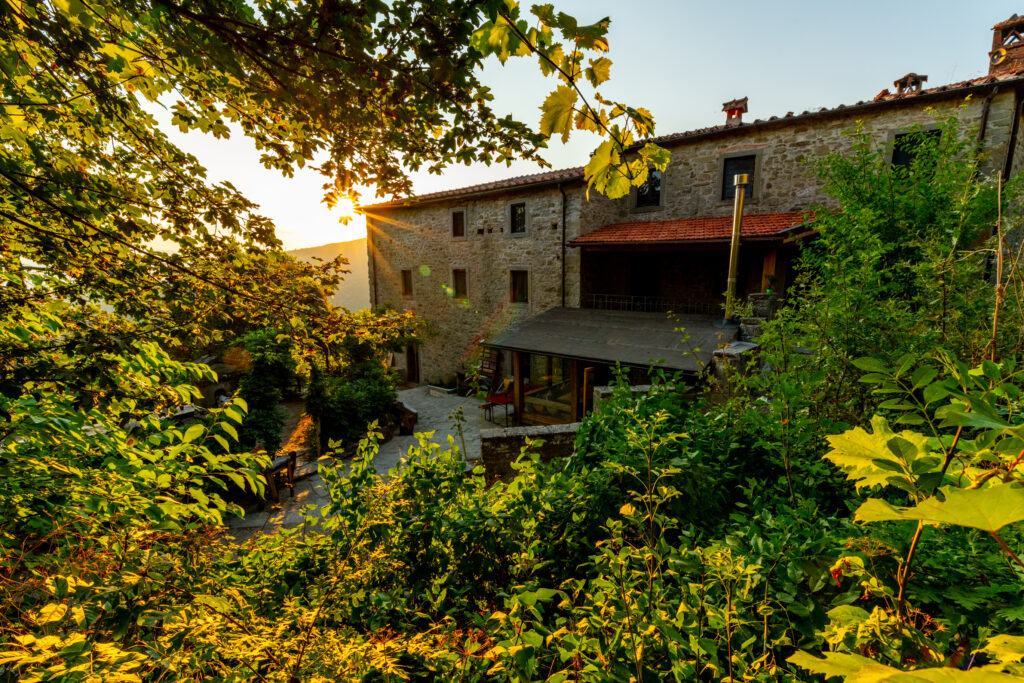
Novanta is an experiential hotel tucked away in the Gello valley in the Casentino, surrounded by three hundred hectares of nature bordering the Casentino National Park. It is not a holiday park or a five-star resort, but an authentic Tuscan borgo where families find the space, freedom, and activities that bring culture and nature together.
What Novanta specifically offers for families with children:
- Self-contained holiday homes with their own kitchen, two or three bedrooms, and space for multiple families together
- Car-free village, the car stays at the entrance, luggage travels with the 4×4, children play freely on the paths
- Activities with local guides: truffle hunting, pasta making, foraging trips, wine tastings, and Italian lessons
- E-mountain biking through the hills of the Casentino, suitable for all levels
- Two swimming pools and a river within walking distance for those who prefer wild swimming
- Meals at long tables, based on the cucina povera, where children taste what the land provides
Novanta is the answer for families looking for a child-friendly agriturismo in Tuscany without compromising on authenticity. View the available holiday homes and plan your stay in the Gello valley.
Frequently Asked Questions
How long should a day trip last to keep children engaged in Tuscany?
Most day trips work best when they last between one and three hours, including travel time. Children lose focus after an hour during passive activities such as museum visits, but can easily stay engaged for two to three hours during active experiences such as truffle hunting or e-mountain biking. It is better to plan two short outings per day than one long programme that overruns.
What do you do if children become tired or grumpy during a city visit?
The best remedy is an immediate switch: find a terrace, order a gelato or granita, and give children twenty minutes of free time in a square or park. Do not try to push through the programme, as a forced city visit leaves a negative memory. Always build a ‘escape route’ into your daily plan in advance, such as a playground or an ice cream parlour near the attraction.
Are there activities in Tuscany specifically for children under six?
Yes, although young children need a different kind of programme. Making pasta, feeding animals on a farm, playing in a stream, or a short walk through the forest are ideal for children aged two to six. Avoid long car journeys, busy cities, and extensive guided tours. A holiday home with its own garden or outdoor space is a must for this age group, so children can simply play freely without a schedule.
How do you prepare children at home for a cultural holiday in Tuscany?
Good preparation starts weeks before departure: read a children’s book together about the Middle Ages or Italian tales of knights, learn a few Italian words such as ‘grazie’ and ‘buongiorno’, or cook pasta from fresh ingredients at home once. Children who already have a frame of reference recognise things on the spot and are far more enthusiastic. Make it a game, not homework.
Is an agriturismo or holiday home better than a hotel when travelling with children?
For most families, a holiday home or agriturismo is the better choice. You have your own kitchen for breakfast and dinner, more space for children to move around, and no hotel rules about silence or fixed meal times. An agriturismo also offers the opportunity to truly experience the local surroundings rather than just passing through them. Hotels work better for short city trips of one or two nights.
What are common mistakes made by parents visiting Tuscany with children for the first time?
The most common mistake is fitting too much into too little time. Parents want to see Florence, Siena, Pisa, and the countryside in one week, resulting in exhausted children and frustrated parents. Choose one region as a base and take it easy. A second common mistake is travelling in the hottest weeks of August without accounting for the midday heat, which can be genuinely taxing for young children.
How do you make sure children genuinely enjoy Italian food?
Involve children actively in the food: let them help with cooking, choose ingredients themselves at the market, or order a dish in Italian. Children who have rolled their own pasta will also eat that pasta. Do not be afraid of simplicity: Italian kitchens are naturally child-friendly, with pasta, bread, tomatoes, and cheese as a base. Resist the temptation to choose only restaurants with a children’s menu, because it is precisely the simple local trattoria that offers the most authentic and flavourful experience.
