

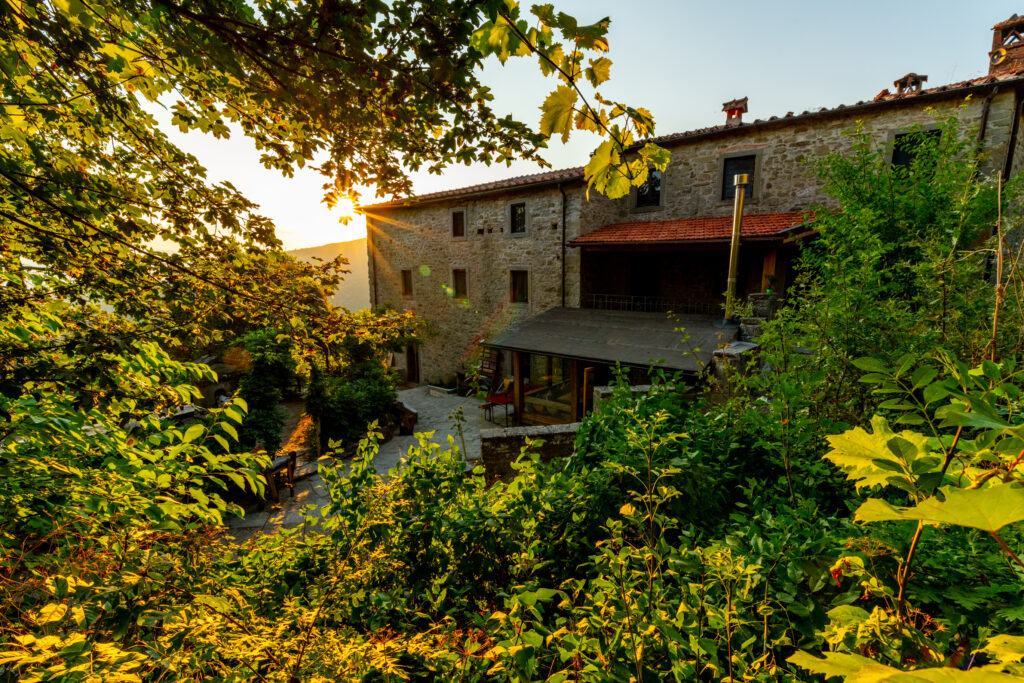
In the Tuscan hills, you can encounter a surprisingly rich wildlife population with children: from roe deer and wild boar to lizards, eagles, and even wolves in the more remote areas. Tuscany is one of the greenest regions of Italy, with vast forests and national parks that serve as habitat for dozens of wild animal species. The questions below will help you know exactly what to expect, what is safe, and how to spot the most animals.
What wild animals live in the Tuscan hills?
The Tuscan hills are home to a remarkably diverse fauna. In the dense oak and chestnut forests live roe deer, wild boar, badgers, foxes, and stone martens. Higher and more remote areas, such as around the Casentino National Park, are even home to wolves and the rare Apennine lynx. For children, that awareness alone is already an adventure.
Above the tree line, birds of prey such as the common buzzard, the red kite, and occasionally an eagle circle overhead. In the rivers and streams live otters and various fish species. The richness of wildlife in the Tuscan hills is partly due to the protection offered by national and regional parks: here, human activity is limited and nature can take its course.
Which animals can you easily spot during the day in Tuscany?
During the day, roe deer, lizards, butterflies, and various bird species are the easiest to spot in Tuscany. Roe deer are especially active in the early morning and late afternoon, but also appear at quiet midday hours at the forest edge. Lizards love to sunbathe on stone walls and paths and are a fun first discovery for children.
- Roe deer: Visible at forest edges, especially at dawn and dusk
- Lizards: On warm stones and low walls throughout the day
- Butterflies: On flower-rich meadows and along forest edges in summer
- Birds of prey: Circling above open slopes, clearly visible from higher vantage points
- Wild boar: More often in the evening and at night, but their tracks are easy to find during the day
- Frogs and salamanders: Near streams and pools, especially after a rain shower
With children, it is smart to bring a small pair of binoculars and walk quietly. Animals in the Tuscan countryside are shy but curious: those who stand still and have patience are rewarded.
Are there dangerous animals in Tuscany to watch out for?
Tuscany has no life-threatening animals, but a few species deserve attention. The most relevant are scorpions, adders, and processionary caterpillars. Scorpions in Tuscany are small and their sting is painful but not life-threatening for healthy adults and children. They like to hide under stones, in cracks in old walls, and sometimes in shoes that have been left outside.
Adders (the common viper) occur in rocky, sunny areas. They rarely bite unless they are picked up or stepped on. Tell children never to rummage under stones or in bushes without looking first. Pine processionary caterpillars are recognizable by their long lines and are dangerous to touch: the hairs cause serious skin irritation and can cause more serious injury on eye contact. Keep children away from white nests in pine trees.
Additionally, there are wasp and hornet nests in old walls and hollow trees. Staying alert is worthwhile, but there is no need for fear: millions of people walk through the Tuscan countryside every year without problems.
What are truffles and which animals help in the search?
Truffles are underground fungi that grow in symbiosis with tree roots, particularly oak and hazel. They are not visible on the surface and emit a strong scent when they are ripe. Because of that scent, trained dogs are used to locate truffles: the dog smells the truffle underground and carefully digs toward the spot.
In the past, pigs were used for truffle hunting, but dogs have taken over because they are easier to train and are less likely to eat the truffle. In the Casentino area, mainly black summer truffles are found, but the white truffle also occurs in the region. A truffle hunt with a local guide and a well-trained dog is one of the most memorable experiences in the Tuscan countryside for children.
How do you recognize animal tracks and signs in the forest?
You recognize animal tracks by paw prints in soft ground, gnaw marks on trees, droppings, and broken branches. In the Tuscan forests, the tracks of wild boar are the most striking: they root up the forest floor in search of roots and insects, leaving large patches of churned ground. Roe deer tracks are narrow and pointed and are clearly visible in mud along forest paths.
- Look for churned ground: Indicates wild boar or badgers that have been searching for food
- Watch for bark damage on trees: Deer rub their antlers on young trees; this leaves characteristic streaks
- Look for paw prints near water: Streams and muddy banks are ideal spots for fresh prints
- Observe droppings: Shape and content reveal the animal — berries in fox droppings, grain in wild boar droppings
- Listen for sounds: Snapping branches, rustling in bushes, or bird alarm calls indicate movement nearby
A simple track guide or a nature app on your phone turns this into a real expedition for children. Reading the forest is a skill you do not quickly forget.
When is the best time to see animals in Tuscany?
The best time to see wild animals in Tuscany is early in the morning or just before sunset, regardless of the season. In the summer months, animals are more active during the cooler hours of the day. Spring and early autumn are the richest periods for wildlife observation: birds are nesting, young roe deer are exploring their surroundings, and the forests buzz with activity.
For families traveling during the Dutch or Belgian summer holidays (mid-June to late August), the advice is to make use of the early morning. A walk at seven o’clock through the hills almost always yields more than a trip during the hottest part of the day. Wild boar are almost exclusively active in the evening and at night, but their tracks can be found everywhere during the day.
Butterflies and insects reach their peak in June and July, making summer the most colorful period for children. Birds of prey are easiest to spot on warm afternoons when they rise on thermals above the open slopes.
Discovering animals from Novanta in the Gello valley
Novanta is nestled in the Gello valley, surrounded by some 300 hectares of forest and meadows, bordering the Casentino National Park. This makes the borgo an excellent base for families who want to experience the Tuscan countryside up close, without having to drive far or follow busy tourist routes.
What Novanta concretely offers for families who want to discover nature and wildlife:
- Truffle hunting with a local guide and trained dog, a hands-on experience children will not soon forget
- Guided foraging walks through the surrounding forests, with attention to tracks, plants, and animals
- Car-free village, no traffic, allowing animals to venture into the valley and children to roam freely
- Direct access to forest paths from the holiday homes and hotel rooms, without having to get in the car first
- River in the valley as an ideal spot to observe amphibians, dragonflies, and birds
Whether you choose a holiday home in Tuscany with its own kitchen for multiple families, or a hotel room or cottage as a smaller family, the nature of the Casentino hills is literally on your doorstep. Contact Novanta to find out which experiences are available during your travel period.
Frequently Asked Questions
How do I prepare my children for a nature walk in the Tuscan hills?
Make sure to have sturdy hiking shoes that support the ankles, long trousers to avoid contact with processionary caterpillars and nettles, and a bottle of insect repellent. Bring a small pair of binoculars and a nature app or track guide to actively involve children in the search. Discuss the basic rules in advance: never rummage under stones, avoid white nests in pine trees, and always be quiet when you spot an animal.
What should I do if my child is stung by a scorpion or bitten by an adder in Tuscany?
For a scorpion sting: keep the area clean, cool with ice or cold water, and give a painkiller if needed. Serious allergic reactions are rare but require immediate medical attention. For an adder bite: keep the child calm, move the bitten limb as little as possible, and seek a hospital immediately. Never suck the venom from the wound and do not make an incision — this only makes the situation worse.
Are there good nature apps we can use to identify animals and tracks during our walks?
Yes, a number of apps work excellently in the Tuscan countryside. iNaturalist is ideal for identifying animals, plants, and insects via a photo and also works offline. Merlin Bird ID by Cornell Lab is specifically for birds and can recognize species even based on bird sounds. For tracks, the app iTrack Wildlife is useful, with an extensive database of European animal prints and signs.
Are you allowed to feed or touch wild animals if you encounter them in the Tuscan countryside?
No, feeding and touching wild animals is strongly discouraged, also in Tuscany. Food that does not belong to the natural diet can make animals sick and make them dependent on humans, which reduces their chances of survival in the wild. Never touch young animals you find — such as a young fawn — never touch them: the scent of humans can cause the mother to abandon the young. Observing from a distance is always the right choice.
What is the difference between a guided nature walk and hiking independently in the Casentino hills?
On a guided walk, you benefit from the knowledge of a local guide who knows exactly where animals are active, which tracks are fresh, and how to read the forest — knowledge that takes years to build up through independent hiking. For children, a guide makes the experience much more vivid: they ask questions, get direct answers, and remember it much better. Independent hiking is also valuable, but preferably combine it with at least one guided walk as a foundation.
Can we also spot wild animals in Tuscany in winter, or is summer really the best period?
Winter is actually an underrated period for wildlife observation in Tuscany. Without a leaf canopy, animals are more visible in the forests, and birds of prey and wolves are more actively searching for food. Tracks in snow or wet ground are also exceptionally easy to read. Summer has the advantage of butterflies, amphibians, and young animals, but those who travel in winter largely have nature to themselves.
How likely is it that we will actually see a wolf during our stay in the Casentino?
The chance of seeing a wolf is small but not zero: wolves are shy and actively avoid people, but in the Casentino National Park several packs live and they are regularly spotted by local rangers and hikers. Most families do not see a wolf but do find tracks: large paw prints in mud, droppings, or signs of an attack on wildlife. A local guide significantly increases your chances and knows which areas and times are most promising.
