

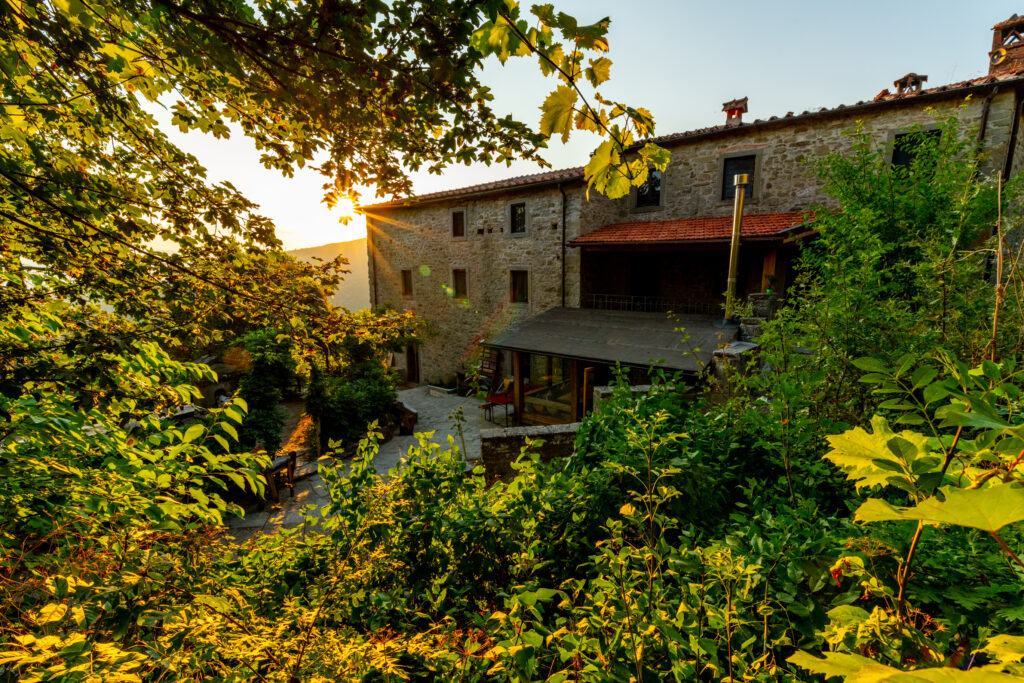
An agriturismo holiday with children in Italy sounds like a dream: space to run, fresh pasta, olive trees and a swimming pool with views of rolling hills. But anyone who starts searching quickly realizes that the offer is enormous and quality varies greatly. Especially for families planning a family holiday in Tuscany or northern Italy, it’s worth pausing to consider what an agriturismo actually entails, where the best options are, and what to look out for before you book.
This article gives you concrete information to help you make a choice that truly suits your family.
What sets an agriturismo apart from a regular hotel
An agriturismo is at its core a working agricultural business that also welcomes guests. That sounds simple, but the difference from a regular hotel is significant in practice. Where a hotel runs on service and standardization, an agriturismo runs on place, rhythm and authenticity.
Guests sleep on or near a farm, a vineyard or a borgo, surrounded by the landscape that determines the food on the table. The owners are often the farmers, cooks or guides themselves. There’s no room service, but there is a self-picked herb garden, a shared table at the end of the day and the sound of crickets instead of air-conditioning units.
For children, that difference is actually an advantage. They see where food comes from, meet animals, have space to move around and don’t end up in an environment entirely geared toward tourists. It does ask something of the family: a certain willingness to enjoy what’s there, rather than what’s arranged.
Northern or Central Italy: where are the best agriturismi for families
Italy has thousands of agriturismi, but not every region is equally suitable for families with children. The choice between north and central depends on what you’re looking for: nature, culture, warmth or accessibility.
- Tuscany (central Italy): The most classic choice for a family holiday. Gentle hills, medieval villages, excellent culinary traditions and a wide range of family-friendly agriturismi. Regions such as the Casentino, Chianti and Maremma each offer their own character.
- Umbria: Quieter and less touristy than Tuscany, with beautiful nature and an authentic Italian feel. Ideal for families who want to avoid crowds.
- Veneto and Friuli (northern Italy): More variety in landscape, from the Dolomites to wine valleys. Suitable if you also want to combine mountain hikes or more adventurous activities.
- Emilia-Romagna: Culinarily one of the richest regions in Italy. Lesser-known agriturismi, but excellent for families who love food and want the Adriatic coast as a bonus.
For most Dutch and Belgian families, Tuscany is the most logical choice: easily accessible via Pisa or Florence, familiar in climate and with a rich selection of accommodations. The Casentino valley, east of Arezzo, is a special option within that: less well-known, but for that very reason authentic and peaceful.
Activities on and around an agriturismo that captivate children
A good agriturismo for families offers more than a swimming pool and a beautiful setting. Children need structure, but also the freedom to explore. The best experiences combine both.
Think of activities that are truly connected to the place and the season, rather than generic entertainment. That is precisely what makes agriturismi stand out compared to holiday resorts.
Activities that work well with children
- Truffle hunting: Walking through the forest with a guide and a sniffer dog in search of truffles is a real experience for children of all ages. Exciting, active and educational all at once.
- Making pasta: Hands in the dough, making your own pasta and eating it that evening. Children love taking part in this and the result is immediately visible.
- Hiking and cycling: Many agriturismi are located in or border nature reserves. E-mountain bikes make even longer routes accessible for families with children who can’t yet cycle very far.
- Swimming: A swimming pool with views of the hills is the perfect base for children to spend an afternoon doing nothing. Combine that with a nearby river for extra adventure.
- Foraging trips: Searching for herbs, wild berries or mushrooms in the surrounding area gives children a different perspective on nature and food.
What to look out for when choosing an agriturismo with children
Not every agriturismo is suitable for families, even if the website says “family-friendly.” A few concrete points help you make the right choice.
First, look at the type of accommodation. An independent holiday home with its own kitchen gives families much more flexibility than a hotel room: children can eat at their own pace, there’s space to play and you don’t have to go out for dinner every evening. For larger groups, such as multiple families travelling together, that difference is even more important.
In addition, these are the points that make the most difference:
- Safety of the surroundings: Is the grounds car-free or is there traffic? Can children move around freely without constant supervision?
- Swimming pool: Is there one, is it fenced and what is its quality? A good swimming pool is almost indispensable for families with children in summer.
- Kitchen or catering options: Are there facilities to cook for yourself? Are there options for picky eaters?
- Accessibility: How far is the nearest supermarket? Are there medical facilities nearby?
- Age-appropriateness of activities: Are the experiences on offer genuinely suitable for the age of your children?
An agriturismo that communicates honestly about what it does and doesn’t offer is always a better sign than one that promises everything. Authenticity sometimes comes with minor inconveniences, and that is precisely what makes the experience special.
The best time to travel for an agriturismo holiday in northern Italy
The climate largely determines how you experience an agriturismo holiday. Summer is the most popular, but not always the most comfortable, especially not for active families who also want to hike or cycle.
May and June are excellent months: the landscape is green, temperatures are pleasant and the crowds of high season have not yet peaked. Activities in nature are most appealing then. July and August are the warmest and busiest months, but also the period when most Dutch and Belgian families travel due to the summer holidays. Choose a location at altitude, in the hills, where temperatures are somewhat more bearable than on the coast or in the plains.
September is for many families without school-age children the best month: the crowds diminish, temperatures are pleasant and in Tuscany the truffle and wine harvest begins. That makes the culinary experiences at an agriturismo extra special then.
How Novanta makes the perfect agriturismo holiday for families possible
Novanta combines everything that makes a great agriturismo holiday with children special, in one unique location in the Casentino hills of Tuscany. The borgo is car-free, nature begins right outside the door and there is no entertainment programme to disturb the peace.
Concretely, Novanta offers the following for families:
- Independent holiday homes with their own kitchen, suitable for families and larger groups of multiple families travelling together
- A 20-metre swimming pool and access to the river in the valley
- Guided experiences such as truffle hunting, pasta making, foraging trips and e-mountain biking
- Meals at long tables, based on Tuscan cucina povera, with local and seasonal ingredients
- A car-free village where children can move around freely
- Location bordering the Casentino National Park, with endless hiking and cycling possibilities
Novanta is not a luxury resort and does not aspire to be one. It is a place for families who truly want to enjoy Tuscany, the nature, the people and the simplicity. Take a look at the website and discover which accommodation suits your family best.
Frequently Asked Questions
Hoe ver van tevoren moet ik een agriturismo boeken voor een zomervakantie met kinderen?
Voor de populaire zomermaanden (juli en augustus) is het sterk aan te raden om minstens vier tot zes maanden van tevoren te boeken, zeker voor gezinsvriendelijke agriturismi met zelfstandige vakantiehuizen en een zwembad. Die zijn het snelst volgeboekt. Wil je reizen in mei, juni of september, dan heb je iets meer speelruimte, maar ook dan geldt: hoe eerder, hoe beter, vooral als je met meerdere gezinnen samen wilt reizen.
Wat is de minimumleeftijd voor activiteiten zoals truffels zoeken of pasta maken?
De meeste agriturismi bieden truffelzoektochten en pastaworkshops aan voor kinderen vanaf ongeveer vier à vijf jaar. Jongere kinderen kunnen vaak wel meekomen, maar participeren dan beperkter. Voor wandel- en fietsactiviteiten hangt de geschiktheid sterk af van de route en het gebruik van hulpmiddelen zoals fietsstoeltjes of e-mountainbikes. Vraag bij de specifieke agriturismo altijd even na welke leeftijdsgroepen ze gewend zijn te ontvangen.
Is een huurauto noodzakelijk als ik verblijf op een agriturismo in Toscane?
In de meeste gevallen is een huurauto sterk aan te raden, omdat agriturismi doorgaans buiten de bebouwde kom liggen en openbaar vervoer in landelijke gebieden beperkt is. Voor daguitstapjes naar middeleeuwse dorpjes, markten of grotere steden zoals Arezzo of Siena is een auto vrijwel onmisbaar. Sommige agriturismi bieden transfermogelijkheden of organiseren uitjes, maar eigen vervoer geeft je als gezin de meeste flexibiliteit.
Wat als mijn kinderen kieskeurige eters zijn — is een agriturismo dan nog steeds een goede keuze?
Ja, zeker als je kiest voor een accommodatie met een eigen keuken, zodat je zelf kunt koken naar de smaak van je kinderen. Veel agriturismi serveren ook eenvoudige gerechten zoals pasta met tomatensaus die bij de meeste kinderen in de smaak vallen. Het is slim om vooraf te informeren naar de menuopties of te vragen of er rekening gehouden kan worden met voedingsvoorkeuren. Een eigen keuken geeft sowieso de meeste flexibiliteit voor gezinnen met kieskeurige eters.
Hoe combineer ik een agriturismo-verblijf met een stedentrip naar Florence of Siena?
Een agriturismo in de Toscaanse heuvels leent zich uitstekend als uitvalsbasis voor één of twee dagtrips naar steden als Florence, Siena of Arezzo. Plan zulke uitstapjes bij voorkeur vroeg in de ochtend om de middaghitte en de drukte te vermijden, en reken op een rijdtijd van één tot anderhalf uur vanuit de meeste landelijke locaties. Wissel stedelijke bezoeken af met rustige dagen op de boerderij, zodat kinderen niet overprikkeld raken en het ritme van de vakantie ontspannen blijft.
Wat is het verschil tussen een agriturismo en een borgo, en welke is beter voor gezinnen?
Een agriturismo is een werkend agrarisch bedrijf dat gasten ontvangt, terwijl een borgo een gerestaureerd historisch dorp of gehuchte is dat als vakantieverblijf is ingericht. Een borgo biedt doorgaans meer ruimte, meer privacy per gezin en een autovrije omgeving, wat het extra geschikt maakt voor gezinnen met jonge kinderen. Veel borgo’s hebben ook agrarische elementen en bieden vergelijkbare ervaringen als een klassieke agriturismo, maar met het voordeel van meer ruimte en zelfstandige accommodaties.
Zijn er ook mogelijkheden om met meerdere gezinnen samen te reizen naar een agriturismo?
Absoluut, en het is zelfs een van de meest populaire manieren om een agriturismo-vakantie te plannen. Kies in dat geval voor een locatie met meerdere zelfstandige vakantiehuizen op hetzelfde terrein, zodat elk gezin zijn eigen ruimte en keuken heeft maar de gemeenschappelijke voorzieningen zoals het zwembad en de activiteiten deelt. Let er wel op dat je vroeg boekt en duidelijk communiceert over het aantal volwassenen en kinderen, zodat de accommodatie goed op jullie groep afgestemd kan worden.
